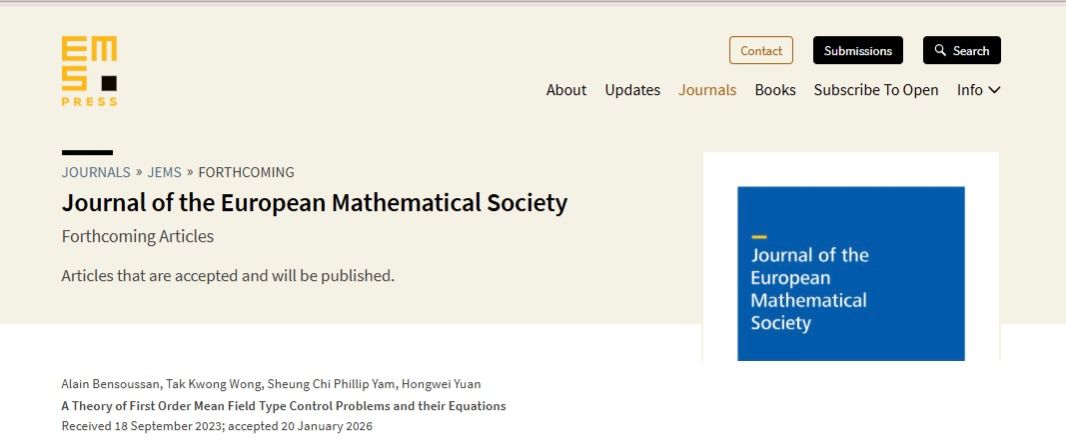
Recently, an academic paper titled “A Theory of First Order Mean Field Type Control Problems and their Equations,” co-authored by Associate Professor Wong Tak Kwong from the Differential Equations and Applications Research Team at the School of Mathematical Sciences, Shenzhen University, along with Professor Alain Bensoussan from the University of Texas at Dallas, Professor Ren Shangzhi from The Chinese University of Hong Kong, and Assistant Professor Yuan Hongwei from the University of Macau, has been accepted for publication in the internationally renowned academic journal “Journal of the European Mathematical Society.”
Mean-field control theory represents an extension of classical control theory to “large-scale agent systems,” aiming to identify globally optimal coordination strategies for vast numbers of interacting individuals—such as autonomous vehicles, financial traders, or social media users. Here, individual decisions are influenced by both their own state and the “mean field” formed by the collective state distribution, which in turn drives the evolution of the mean field, creating a complex infinite-dimensional coupled system. The core tool describing this system is the Bellman equation. However, its highly nonlinear and nonlocal nature has left the existence, uniqueness, and regularity of its solutions unresolved, even under “linear + nonlinear disturbance” dynamics. Existing results largely rely on assumptions such as “linear quadratic forms,” “separable Hamiltonians,” or “globally uniformly bounded second derivatives of the Hamiltonian,” limiting the model's ability to capture complex real-world scenarios. The research team aims to overcome these limitations by establishing a unified, rigorous theory applicable to a broad class of nonlinear dynamic mean-field control problems.
This paper provides the first complete solution for general first-order mean-field control problems, rigorously proving the global existence and uniqueness of classical solutions for both the Bellman equation and the main equation. The research innovatively introduces the “cone condition” and successfully overcomes theoretical bottlenecks in nonlinear dynamic scenarios by analyzing forward-backward systems of ordinary differential equations and employing novel a priori estimation methods (centered on the positive definiteness of the Schur complement of the Hessian matrix of the Lagrangian function). This achievement not only resolves fundamental issues in nonlinear dynamic first-order mean-field control but also provides new tools for higher-order and stochastic scenarios. The thesis further validates its theoretical value by addressing non-trivial nonlinear quadratic examples challenging to solve with conventional methods. It extends this theory to analyze deep residual networks with batch normalization, opening new research perspectives.

Associate Professor Wong Tak Kwong obtained his Bachelor's and Master's degrees from The Chinese University of Hong Kong. He received his Ph.D. in Mathematics from the Courant Institute of Mathematical Sciences at New York University in 2010. His academic career includes postdoctoral research at the University of California, Berkeley; the Hans Rademacher Lectureship at the University of Pennsylvania; and an Assistant Professorship at the University of Hong Kong. He has served as Associate Professor at the School of Mathematical Sciences, Shenzhen University since July 2025. His primary research focuses on the mathematical analysis of partial differential equations, encompassing aspects such as the well-posedness of equations, solution structures, and long-term asymptotic behavior. Specific application domains include control theory, fluid mechanics, integrable systems, dynamical systems theory, mathematical biology, mathematical economics and finance, and mean-field theory.
Associate Professor Wong Tak Kwong has achieved substantial research accomplishments in his field, publishing numerous papers in internationally renowned journals such as Comm. Pure Appl. Math., Arch. Ration. Mech. Anal., Kinetic & Related Models, and Ann. Appl. Probab. He has received multiple grants from the University Grants Committee of the University of Hong Kong and currently leads one National Natural Science Foundation of China (NSFC) General Program project.
Journal citation metrics available at: https://ems.press/journals/jems/articles/forthcoming



