From November 6 to 8, 2026, the “Academic Symposium on Biostatistics and Artificial Intelligence,” organized by the School of Mathematical Sciences at Shenzhen University, was held at Shenzhen University’s Yuehai Campus. The symposium focused on cutting-edge research advances in the fields of biostatistics and artificial intelligence, and invited approximately 40 experts, scholars, and researchers from the Hong Kong University of Science and Technology, City University of Hong Kong, Shanghai Jiao Tong University, Fudan University, East China Normal University, and Sun Yat-sen University to attend. Participants engaged in in-depth discussions on hot topics such as single-cell omics, spatial transcriptomics, genetic statistics, and artificial intelligence, jointly exploring the latest research findings and development trends in these fields.
On the morning of November 7, the symposium officially opened in Room 601 of Huiyan Building at Shenzhen University’s Yuehai Campus. Following an opening address by Professor Yang Can of the Hong Kong University of Science and Technology, the academic presentation session began. The morning sessions centered on the analysis of single-cell and spatial omics data, with a focus on statistical modeling of complex biological data, cell-cell interactions, and innovative applications of related computational methods, demonstrating the crucial role of statistics and computational techniques in unraveling complex biological problems.
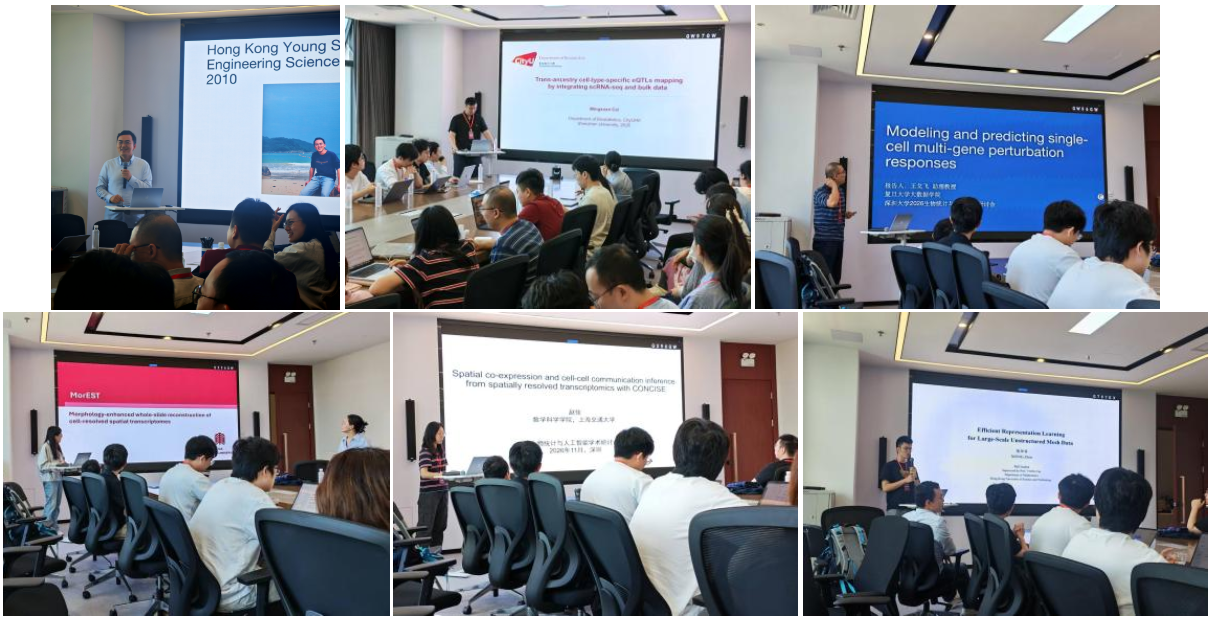
The afternoon’s academic presentations further expanded into research areas such as genetic association analysis, omics data integration, and artificial intelligence methods, focusing on cutting-edge topics including fine-mapping of genetic variants, single-cell eQTL analysis, cell-type-specific causal inference, and spatial omics data analysis, thereby demonstrating the broad application prospects of statistical methods and intelligent computing technologies in life sciences research.
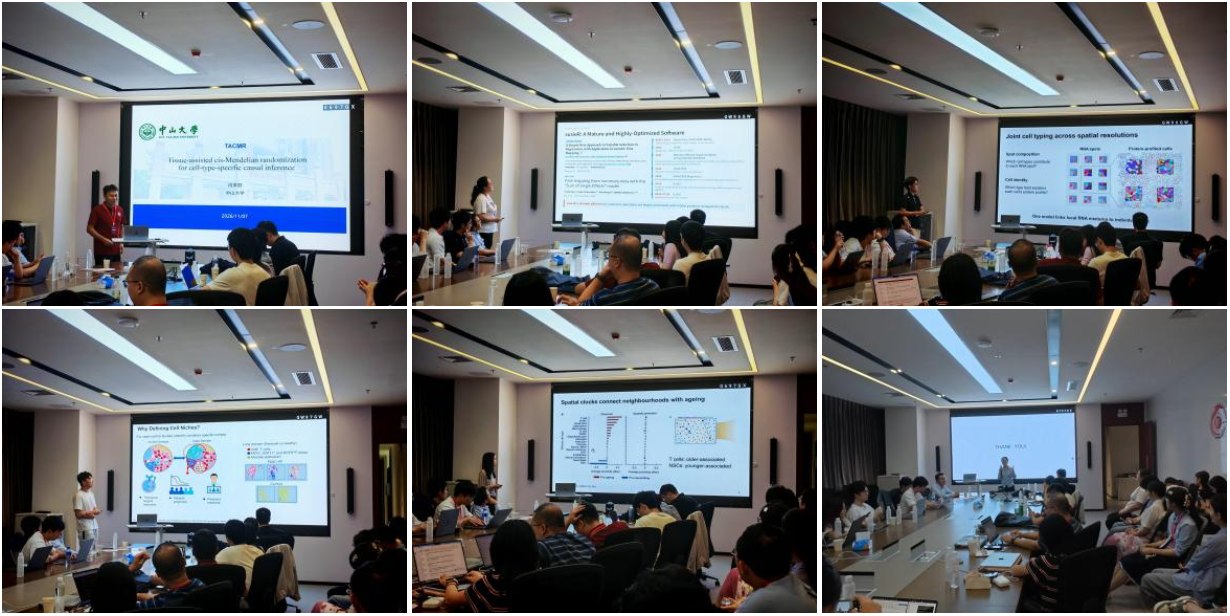
The symposium featured a total of 17 academic presentations and included an open discussion session, providing an excellent platform for participants to exchange research ideas and explore academic issues. The presentations covered statistical theory, algorithmic innovation, and biomedical applications, showcasing the latest research advances in these fields.
Centered on in-depth discussions of cutting-edge statistical theories and their biomedical applications, this symposium strengthened academic exchanges between the School of Mathematical Sciences at Shenzhen University and relevant universities and research teams. It provided an excellent opportunity for the school to expand interdisciplinary research at the intersection of biostatistics and artificial intelligence, deepen scientific collaboration, and advance the development of the field of statistics.



