On the afternoon of June 30, 2026, the 225th lecture of the “Shenzhen University Forum” and the 42nd installment of the Liyuan Distinguished Scholars Lecture Series hosted by the School of Mathematical Sciences were grandly held in Lecture Hall No. 2 of Huixing Building at Shenzhen University’s Yuehai Campus. The lecture featured Liu Jianya, an academician of the Chinese Academy of Sciences and Chair Professor at Shandong University, as the keynote speaker. The title of his presentation was “The Goldbach Conjecture.” The lecture was chaired by Professor Hu Yaohua, Associate Dean of the School of Mathematical Sciences at Shenzhen University.
At the beginning of the lecture, Vice Dean Hu Yaohua delivered opening remarks, extending a warm welcome to Academician Liu Jianya and briefly introducing his academic achievements. Academician Liu Jianya has long been dedicated to research in analytic number theory, achieving a series of significant results particularly in the fields of automorphic forms and the distribution of prime numbers. He has received numerous honors, including the Second Prize of the National Natural Science Award (2014) and the Ho Leung Ho Lee Award for Scientific and Technological Progress (2024).
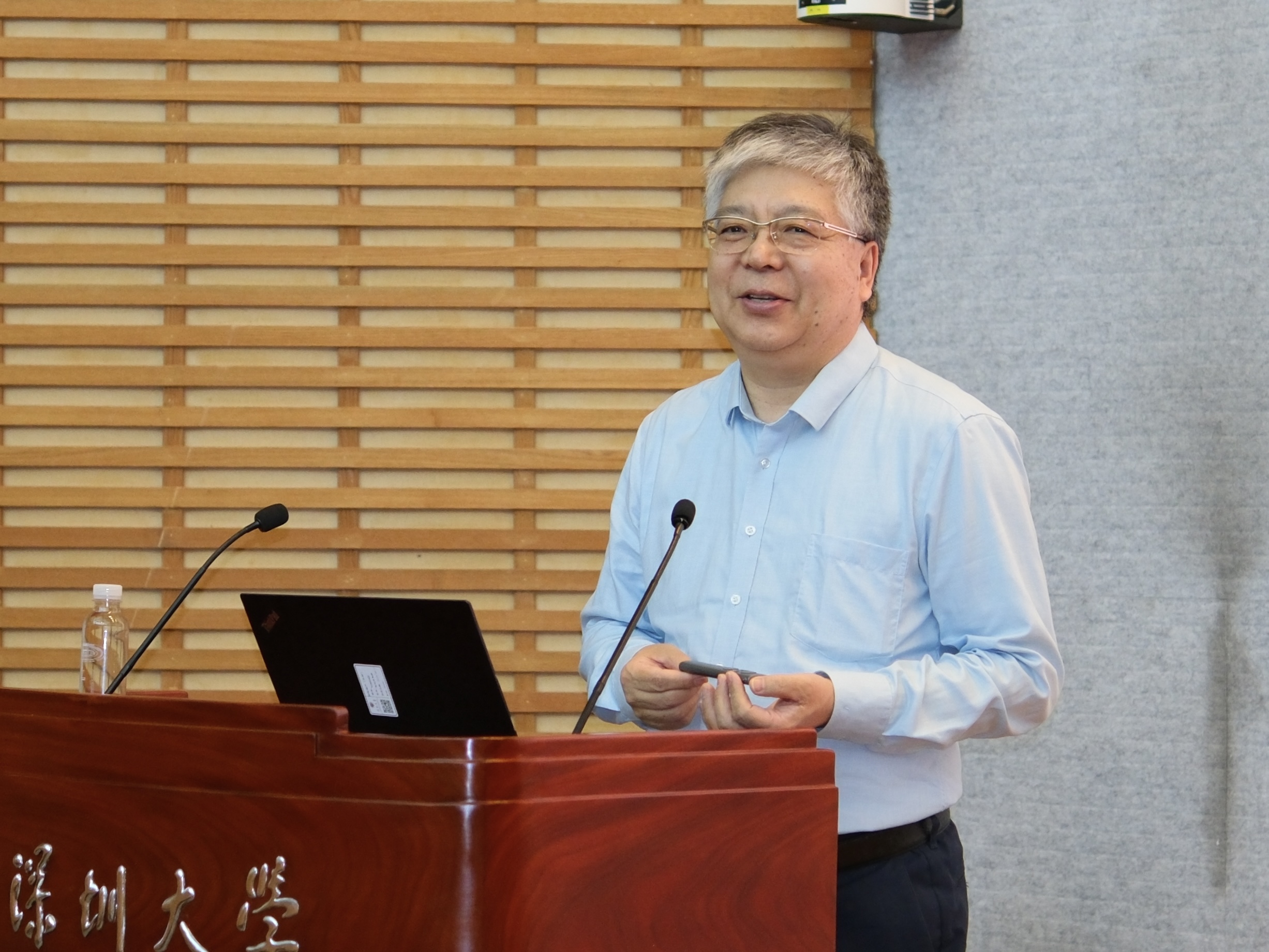
In his presentation, Academician Liu Jianya used clear and accessible language to guide the audience into the fascinating world of the Goldbach Conjecture. Beginning with the basic definition and historical significance of prime numbers, he systematically traced the complete historical trajectory—from Euclid’s proof of the infinity of prime numbers and Gauss’s conjecture on the distribution of prime numbers to the Riemann Hypothesis and the proof of the Prime Number Theorem. He then recreated the scene of 1742 when Goldbach wrote to Euler to propose the conjecture, and elucidated its profound essence: “Any even number greater than 2 can be expressed as the sum of two prime numbers.” He explained that prime numbers are determined by the multiplication of integers, and that the Goldbach Conjecture establishes a very concise relationship between multiplication and addition.
Academician Liu Jianya reviewed more than two centuries of collaborative efforts by mathematicians from China and abroad to tackle this problem, focusing on the Chinese school of number theory: founded by Hua Luogeng and Min Sihe, Pan Chengdong proved “1+5” in 1962, Pan Chengdong and Wang Yuan independently advanced the result to “1+4” in 1963, and Chen Jingrun proved “1+2” in 1966 (the complete proof was published in 1973, and this result remains the best to date). He also mentioned Zhang Yitang’s breakthrough on the Twin Prime Conjecture and other cutting-edge developments such as the Sarnak Conjecture. Academician Liu Jianya shared the latest progress he and his student Li Jiamin have made in their research on the Goldbach Conjecture. They creatively proposed a new proposition, “1+a,” which lies between “1+1” and “1+2,” and achieved an unconditional breakthrough at “1+1.9”—the most significant advancement in this field since 1966.
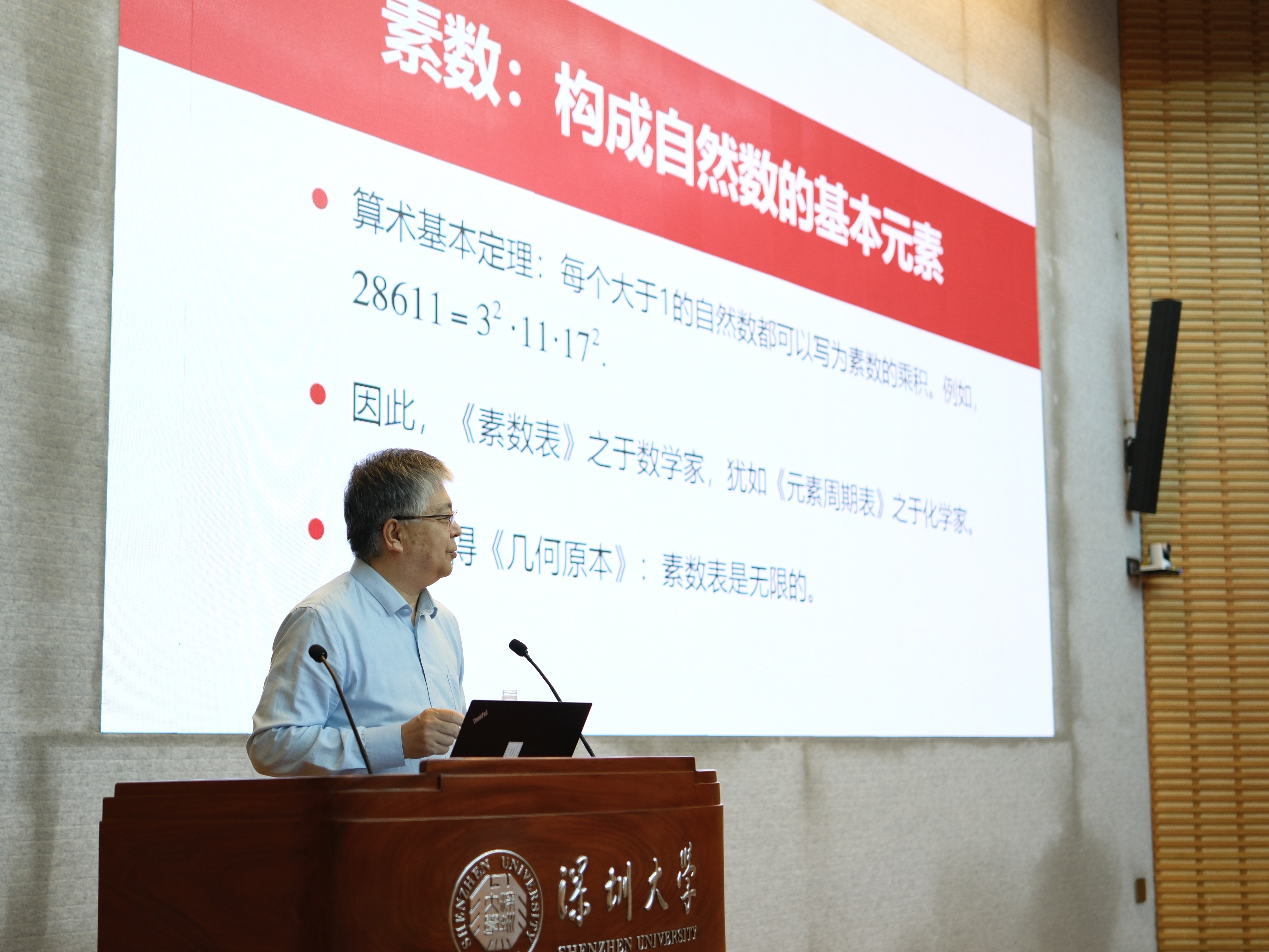
Following the presentation, Academician Liu Jianya engaged in a Q&A session with the faculty and students in attendance, addressing questions one by one on topics such as study methods, research approaches, and cutting-edge developments in number theory. He also encouraged young students to boldly tackle the world’s most challenging mathematical problems. The discussion was in-depth, and the atmosphere was lively.
A plaque presentation ceremony was held afterward.
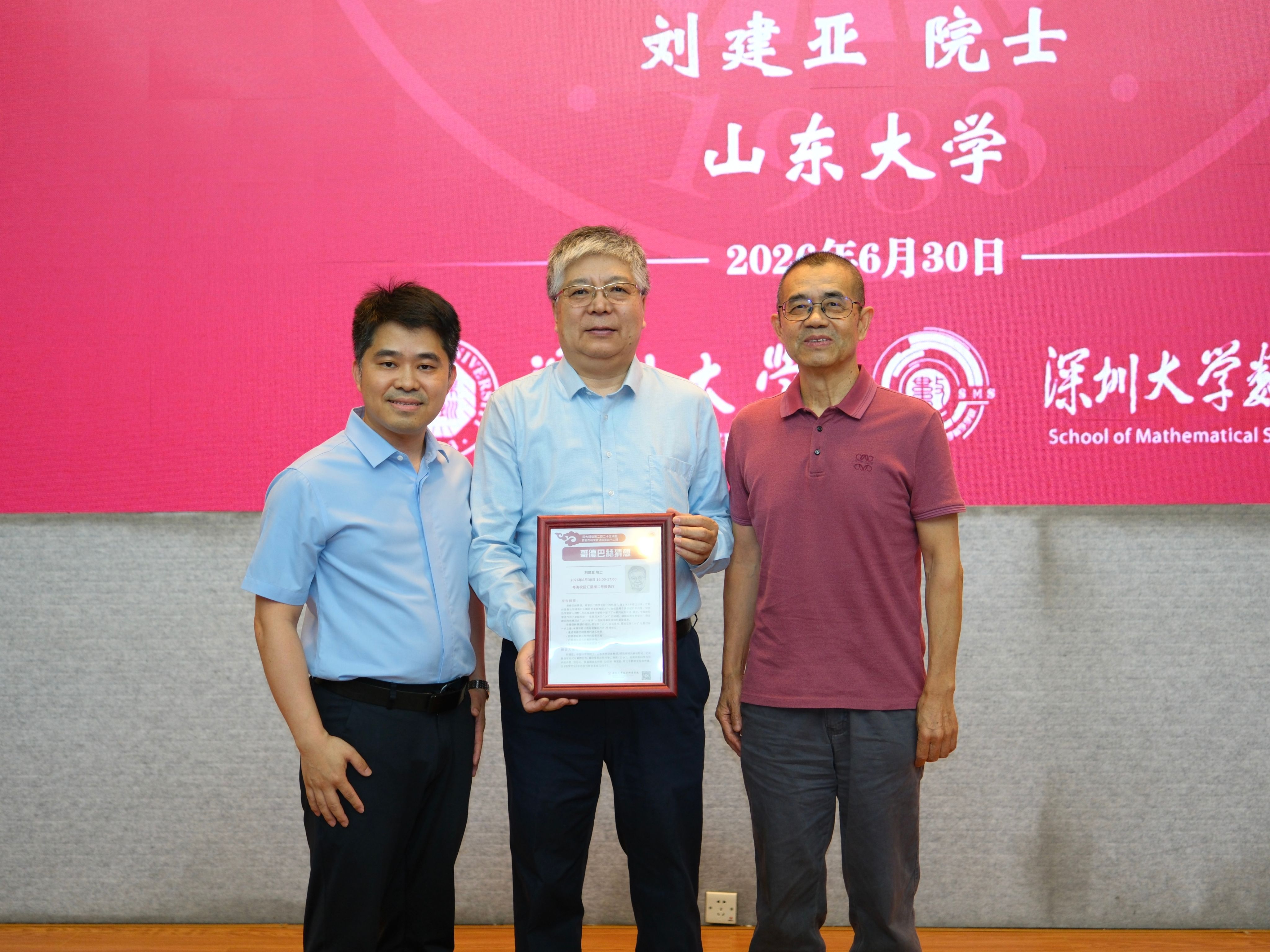
The event concluded successfully amid a rich academic atmosphere. Academician Liu Jianya’s outstanding presentation not only provided faculty and students at Shenzhen University with a high-level academic feast but also offered everyone a valuable opportunity to gain insight into the cutting edge of contemporary mathematics and appreciate the beauty of the discipline. It holds significant importance for advancing the development of the university’s mathematics program and fostering academic exchange.



