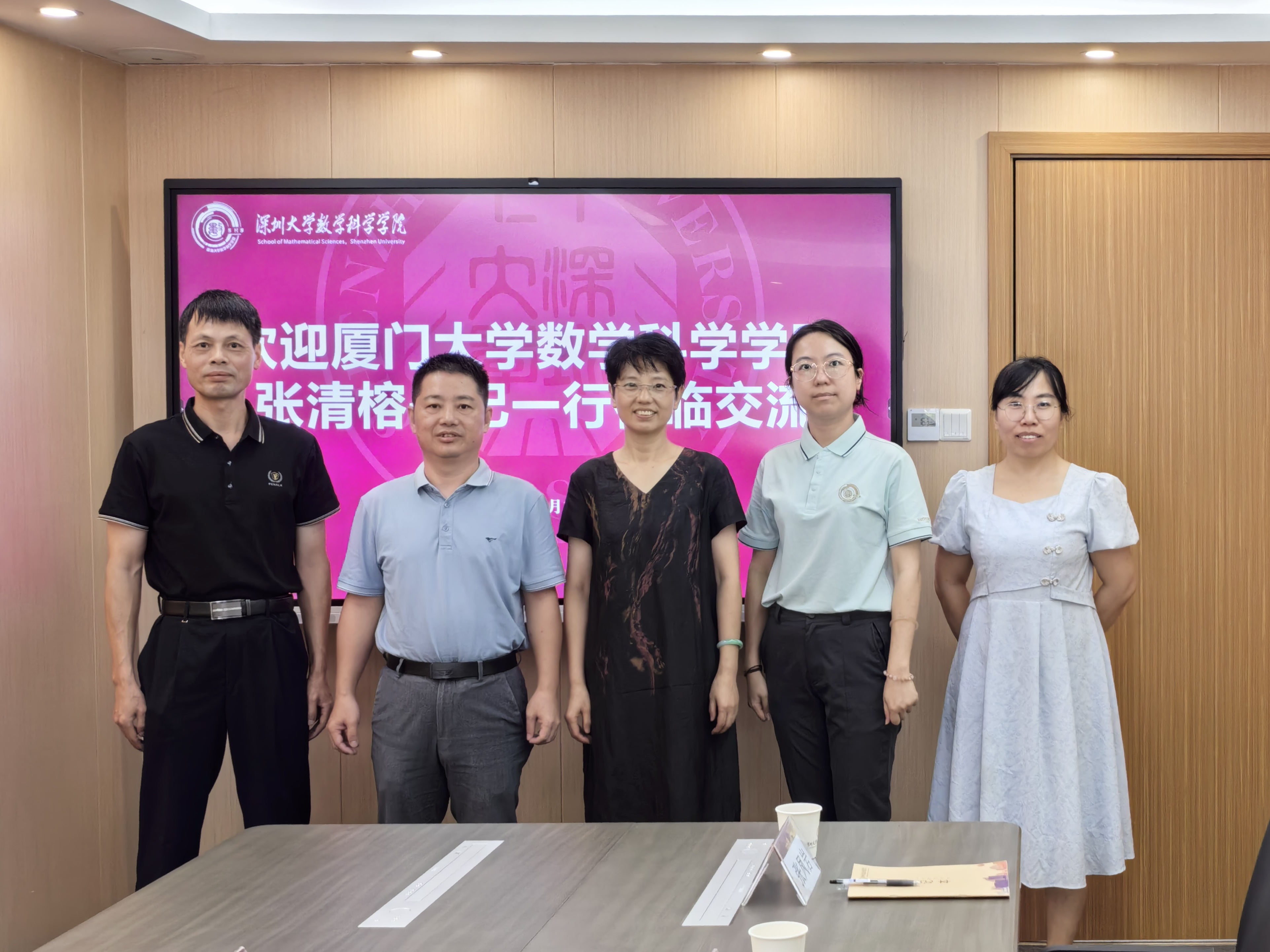
On the morning of August 13, a delegation led by Zhang Qingrong, Party Secretary of the School of Mathematical Sciences at Xiamen University, and Wu Gangmin, Director of the General Office, visited our school for research and exchange. The symposium was held in Conference Room 2331 of Huiwen Building. The two sides engaged in in-depth discussions on Party building, disciplinary development, and performance-based compensation. Wang Yu, Party Secretary of the School of Mathematical Sciences at Shenzhen University, Zhong Xiaoshan, Executive Deputy Director of the Party and Administrative Office, and Zhang Fengyan, Personnel Secretary, attended the symposium.
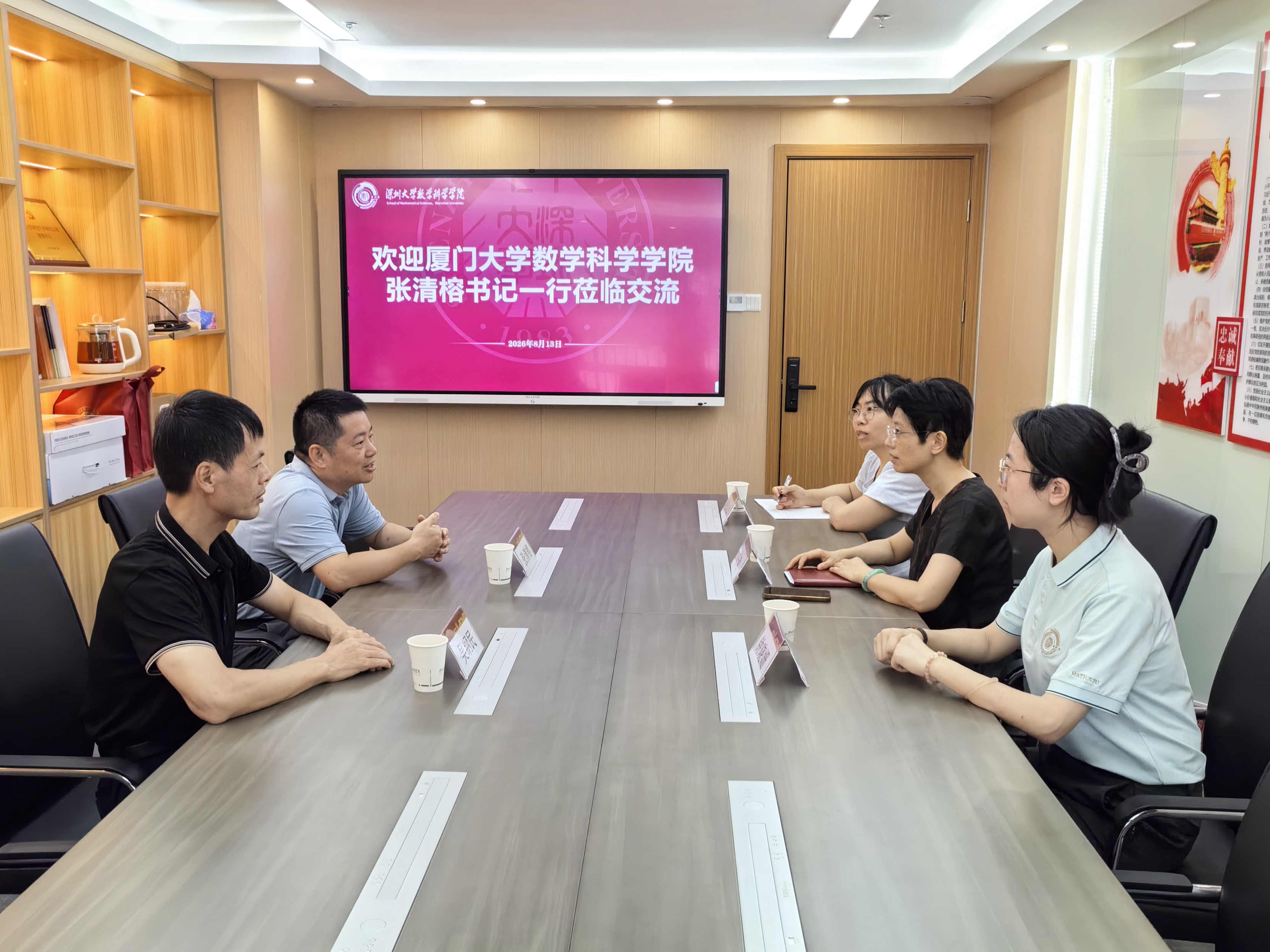
During the symposium, Party Secretary Wang Yu extended a warm welcome to the delegation from Xiamen University’s School of Mathematical Sciences. She outlined the school’s development history and achievements, shared its distinctive approaches to Party building work, and explained specific measures to promote the deep integration of Party building with academic operations. The school remains committed to using high-quality Party building to drive high-quality disciplinary development, while actively serving the needs of major national strategies such as the Guangdong-Hong Kong-Macao Greater Bay Area and the construction of Shenzhen’s Socialist Pioneer Demonstration Zone.
Secretary Zhang Qingrong expressed gratitude for the warm reception extended by the School of Mathematical Sciences at Shenzhen University. He introduced the history and development overview of the School of Mathematical Sciences at Xiamen University, noting that Xiamen University’s mathematics discipline is home to important academic platforms such as the National Tianyuan Mathematics Southeast Center. In recent years, the school has recruited and cultivated a group of outstanding young faculty members and is currently promoting the formulation of a “one-school-one-policy” approach. He expressed hope that this exchange would serve as an opportunity to strengthen mutual learning and exchange, thereby propelling the school’s Party-building efforts to lead disciplinary development and talent cultivation to new heights.
This research and exchange visit not only deepened mutual understanding between the mathematics departments of the two universities, but both parties will also use this opportunity to jointly explore effective pathways for promoting the high-quality development of mathematics through high-quality Party building, and work together to contribute to the advancement of the discipline.