Recently, the internationally renowned statistical journal Biometrics published online an academic paper titled “Localizing support-set changepoints in high-dimensional linear models,” a collaboration between Postdoctoral Fellow Cui Junfeng and Professor Zhou Yan from the School of Mathematical Sciences at Shenzhen University, Professor Wang Junhui from The Chinese University of Hong Kong, and Professor Zou Changliang from Nankai University. Postdoctoral Fellow Cui Junfeng is the first author of the paper, and Professor Zhou Yan is the corresponding author.
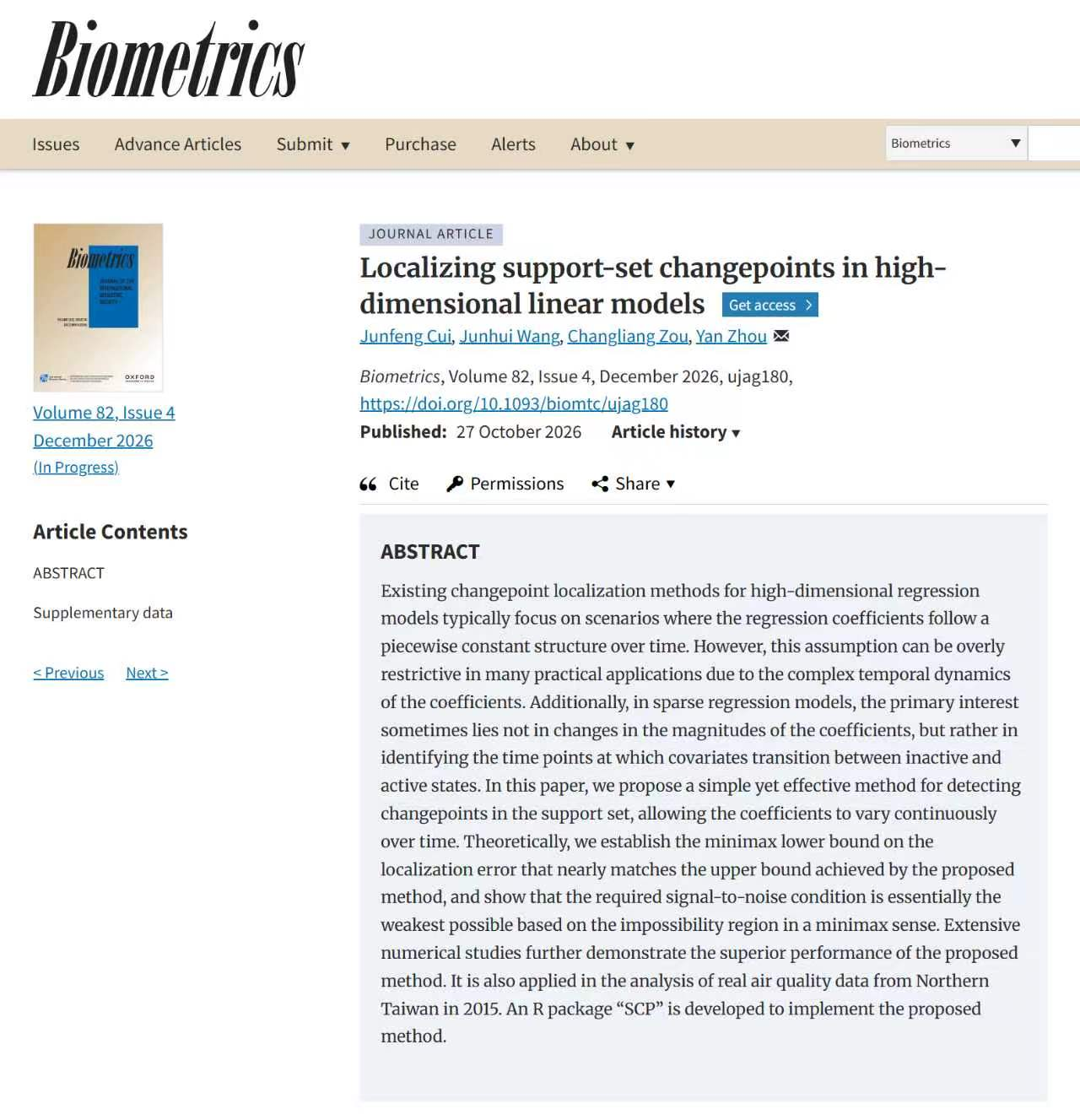
Point change detection is an important research topic in statistics and data science, aimed at identifying the points at which statistical characteristics change as data evolve over time; it has widespread applications in fields such as environmental monitoring, financial analysis, and biomedicine. Existing change-point detection methods for high-dimensional regression models typically assume that regression coefficients follow a piecewise-constant structure, which presents certain limitations when dealing with scenarios where coefficients change continuously over time. This paper focuses on changes in the support set of regression coefficients and proposes a change-point detection method suitable for scenarios where regression coefficients change continuously over time, capable of effectively identifying the moments when covariates enter or exit the model. Theoretically, the paper establishes a lower bound on the estimation error of the support set breakpoint location, proves that the upper bound on the estimation error of the proposed method differs from this lower bound by only a logarithmic factor, and demonstrates that the signal-to-noise ratio (SNR) condition required by the method is close to optimal in the sense of minimax. Additionally, the research team has developed a corresponding R package to facilitate its use by researchers.
Biometrics is an academic journal published by the International Biometric Society. It primarily publishes research on statistical theory and methods, as well as their applications in biomedicine, public health, ecology, and environmental science, and holds broad academic influence in the field of biostatistics and its interdisciplinary applications.
Link to the paper:https://doi.org/10.1093/biomtc/ujag180
Biography:
Cui Junfeng is a postdoctoral researcher at the School of Mathematical Sciences, Shenzhen University. He received his Ph.D. in Statistics from the School of Statistics and Data Science at Nankai University in June 2024. In July of the same year, he joined the Postdoctoral Research Program in Mathematics at Shenzhen University to conduct postdoctoral research. His primary research interests include statistical inference for high-dimensional data and change-point detection. He currently leads one National Natural Science Foundation of China (NSFC) Young Scientists Fund project (Category C) and has published several high-quality SCI papers.
Zhou Yan is a professor at the School of Mathematical Sciences, Shenzhen University. His primary research interests include longitudinal data analysis, biostatistics, and medical statistics. He has led multiple research projects, including the National Natural Science Foundation of China (NSFC) Young Scientists Fund Project and General Projects, and has published nearly 50 papers in high-impact international academic journals such as Genome Research, Biometrics, and Bioinformatics.



