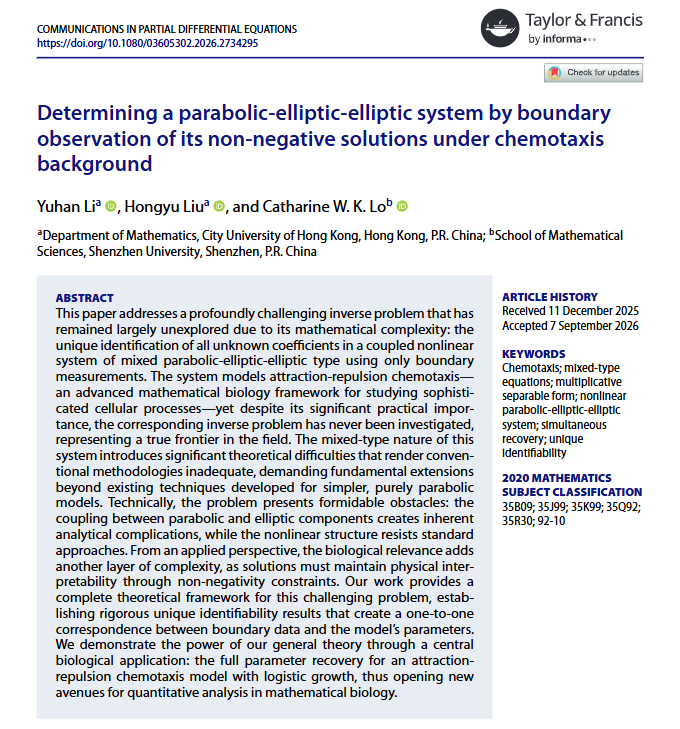
Recently, Associate Professor Lu Yongjun from the School of Mathematical Sciences at Shenzhen University, in collaboration with Professor Liu Hongyu and Dr. Li Yuhan from City University of Hong Kong, published a research paper titled “Determining a parabolic-elliptic-elliptic system by boundary observation of its non-negative solutions under chemotaxis background” in the international academic journal Communications in Partial Differential Equations. The authors are listed in alphabetical order by last name. This work is the first systematic study of the unique identifiability of a class of coupled nonlinear parabolic-elliptic-elliptic chemotaxis systems in the inverse problem, filling a theoretical gap in parameter inversion for hybrid biomathematical models.
Chemotaxis is the phenomenon in which cells or microorganisms move directionally along a chemical gradient; it is widely observed in biological processes such as bacterial aggregation, immune responses, embryonic development, and tumor growth. Since Keller and Segel established the classic chemotaxis model in the 1970s, parabolic and parabolic-elliptic models have been extensively studied. In recent years, attract-repel chemotaxis models—which incorporate both “attraction” and “repulsion” signaling mechanisms—have garnered attention. In these models, cell density is jointly regulated by attractants and repellents, and a logistic growth term is introduced to characterize population saturation. When chemical signal diffusion is much faster than cell movement, the system degenerates into a parabolic-elliptic-elliptic mixed system; this scale separation is a common feature in biological processes.
The inverse problem addresses the following question: Is it possible to uniquely determine all unknown coefficients of the system solely through boundary observations and final-time measurements? Since the system simultaneously contains a time-dependent parabolic equation and an instantaneously balanced elliptic equation, traditional methods for constructing solutions using complex geometric optics face inherent difficulties—while the elliptic component satisfies the elliptic equation, it retains time dependence through coupling, which contradicts the construction of purely spatial harmonic functions.
This paper establishes a comprehensive theoretical framework for the unique identifiability of such hybrid systems, with core results in three areas. First, it proves that, under admissible class conditions, a one-to-one correspondence exists between the measurement mapping and the parameter set—that is, boundary and final-time observation data can uniquely determine all unknown coefficients. Second, for an attract-and-repel chemotaxis model involving logistic growth, it proves that all biological parameters can be simultaneously and uniquely recovered from boundary data. Third, a new method based on higher-order variational calculus and multiplicative separability structures was developed. By combining the Fundamental Theorem of Calculus with the inverse Fourier transform, this method effectively decouples spatio-temporal dependencies, overcomes the analytical difficulties posed by hybrid equations, and substantially generalizes existing results for purely parabolic biological inverse problems to a parabolic-elliptic hybrid framework. The thesis also strictly maintains non-negativity constraints, ensuring that the obtained results are physically interpretable in terms of biological population density.
This research was supported by the National Natural Science Foundation of China (Youth Science Fund, Category C); the Guangdong Province “Pearl River Talent Program” for the Introduction of High-Level Talents (Outstanding Young Talents); the Shenzhen Natural Science Foundation (Youth Project, Category C); the Research Grants Council of Hong Kong (Matching Grant); and the Guangdong Provincial Key Laboratory of Applied Mathematics and Artificial Intelligence.
Link to the paper:https://doi.org/10.1080/03605302.2026.2734295
Biography:
Lo Wing Kwan Catharine is an associate professor in the School of Mathematical Sciences at Shenzhen University under the “Hundred Talents Program.” Her research focuses primarily on inverse problems in partial differential equations, mathematical modeling in biology, and parameter identification. She has published numerous papers in journals such as Journal of Differential Equations, Inverse Problems, Nonlinearity, and Inverse Problems and Imaging, and serves as the principal investigator on a National Natural Science Foundation of China Young Scientist Project.



