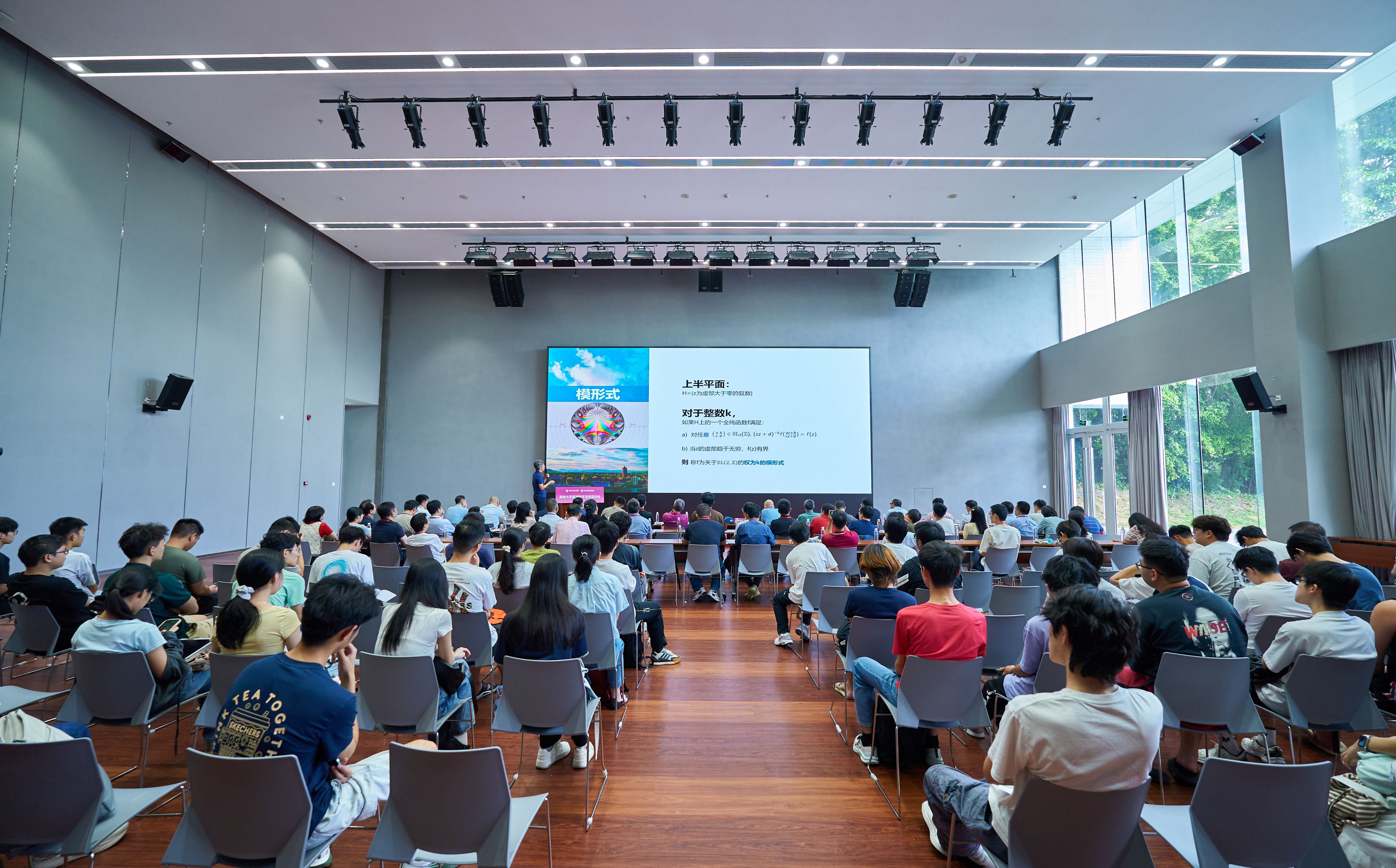
On the morning of June 23, 2026, the 224th lecture of the “Shenzhen University Lecture Series” and the 41st installment of the Liyuan Distinguished Scholars Lecture Series hosted by the School of Mathematical Sciences were grandly held in the Multipurpose Hall of Alumni Plaza at Shenzhen University. Professor Ruochuan Liu, an Academician of the Chinese Academy of Sciences and Dean of the School of Mathematical Sciences at Peking University, was invited as the keynote speaker for this lecture, which was titled “Elliptic Curves, Modular Forms, and Their Applications.” The lecture was chaired by Professor Wang Yuefei, Honorary Dean of the School of Mathematical Sciences at Shenzhen University.
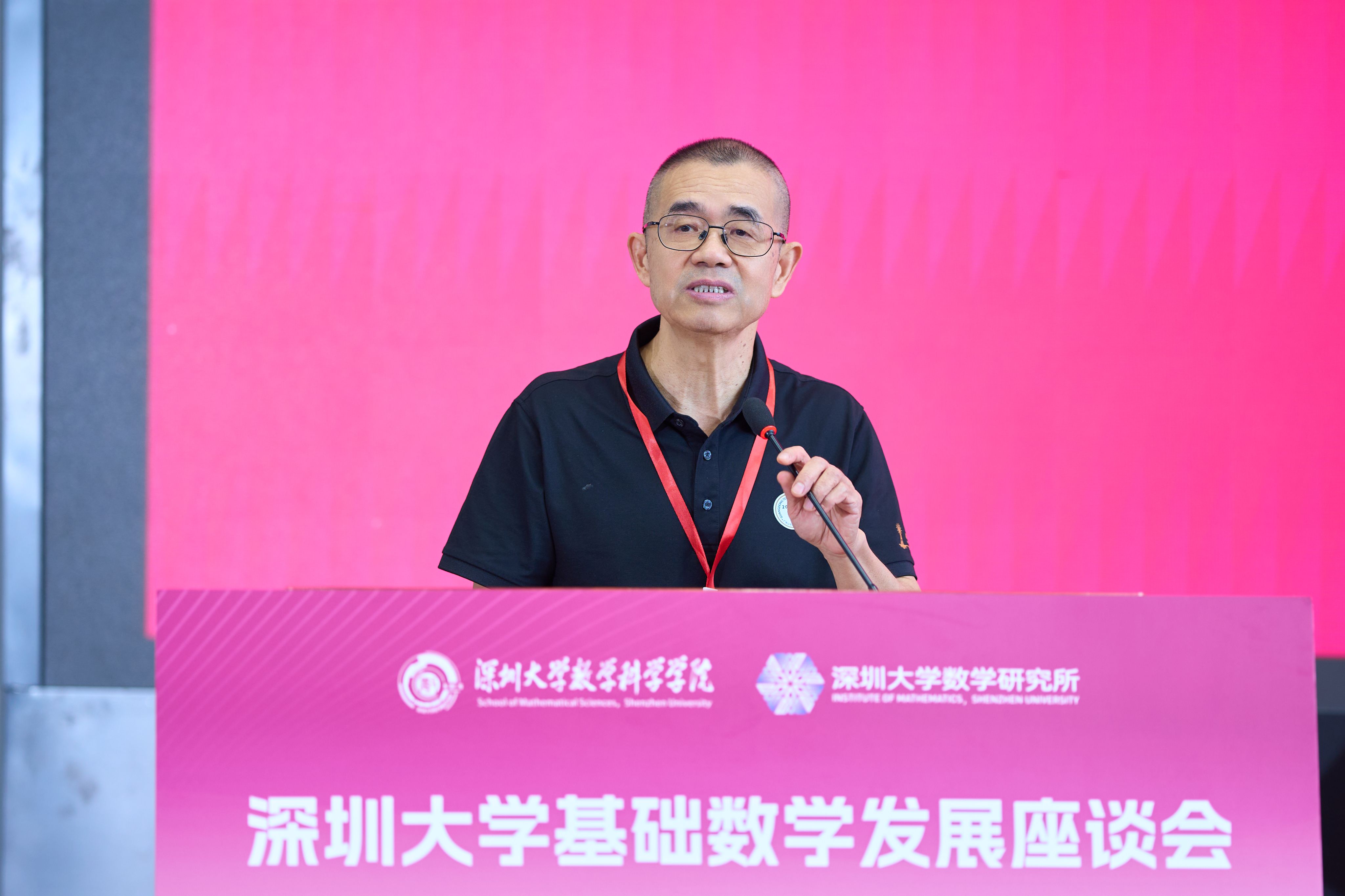
At the beginning of the lecture, Professor Yuefei Wang delivered opening remarks, extending a warm welcome to Academician Ruochuan Liu and briefly introducing his academic achievements. Born in 1980, Academician Ruochuan Liu was elected as a member of the Chinese Academy of Sciences in 2025, becoming the first academician born in the 1980s. He has long been engaged in research on arithmetic geometry and algebraic number theory, achieving a series of significant results in core cutting-edge fields of contemporary mathematics, such as p-adic Hodge theory, p-adic automorphic forms, and algebraic K-theory. He has received numerous honors, including the Second Prize of the National Natural Science Award, the inaugural “Science Exploration Award,” the China Youth Science and Technology Award, the Chen Xingshen Mathematics Award, the ICTP-IMU Ramanujan Prize, and the Ho Leung Ho Lee Foundation Award for Science and Technology Innovation.
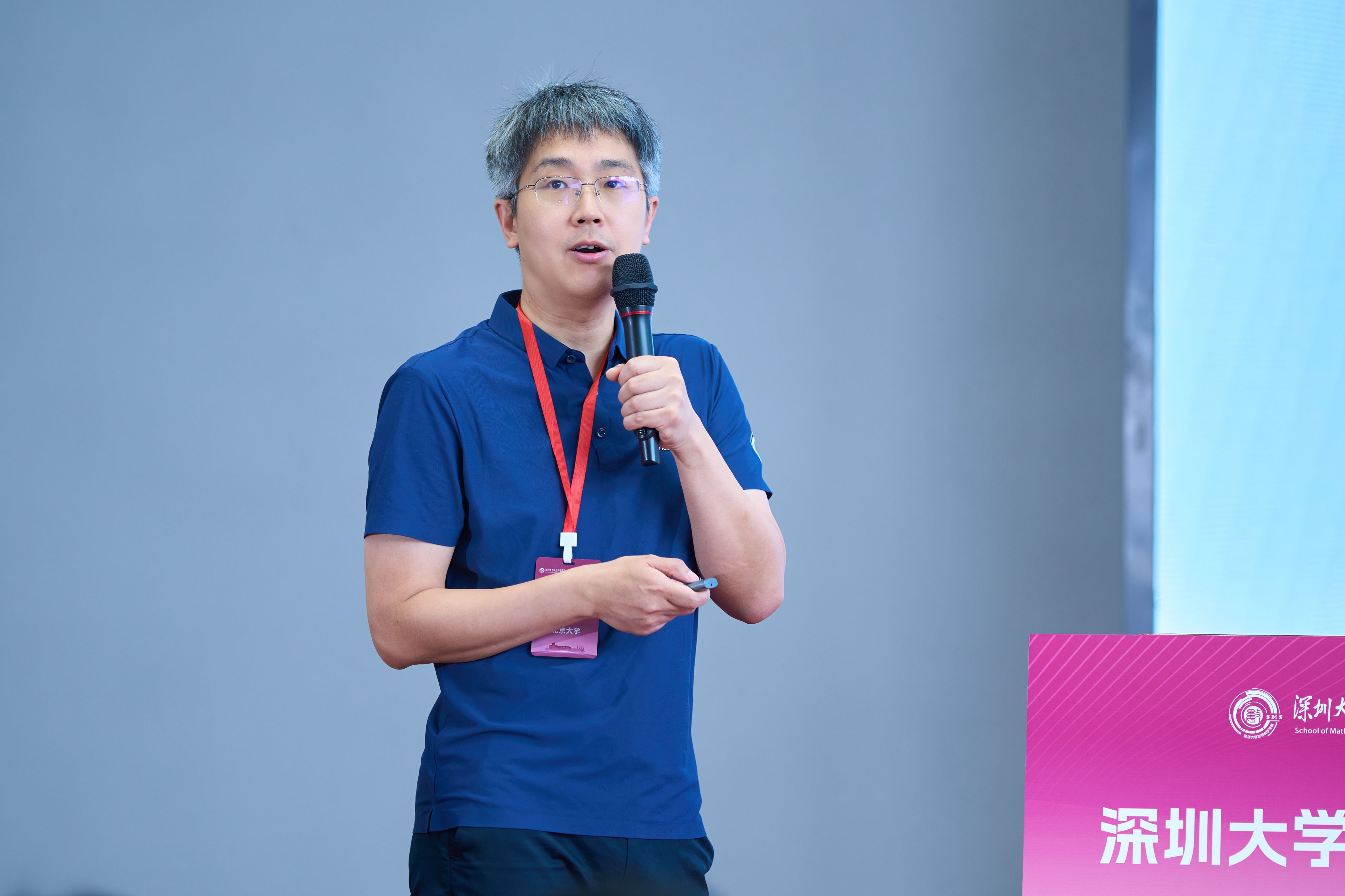
In his lecture, Academician Ruochuan Liu began with classical conic sections and gradually introduced the concept of elliptic curves. By demonstrating how to solve the Pythagorean equation using secants of rational slope on a circle, he vividly illustrated the application of geometric methods to the study of arithmetic problems. He then explained that the rational points on an elliptic curve form a commutative group under addition, thereby introducing the BSD conjecture. Academician Liu also presented the properties of elliptic curves on Riemann surfaces from a topological perspective. Drawing on practical examples—such as comparing the RSA encryption algorithm with the Elliptic Curve Digital Signature Algorithm (ECDSA) and Bitcoin digital signatures—he explained in accessible terms the widespread applications of elliptic curves in modern technology.
Academician Ruochuan Liu then introduced the basic concepts of modular forms and highlighted the significant contributions of the Indian mathematical genius Ramanujan to their development. He explained in detail how the Taniyama-Shimura Conjecture links modular forms to elliptic curves. Using this as a central thread, he provided a popular science explanation of the tortuous journey of the proof of Fermat’s Last Theorem, profoundly revealing the intrinsic and elegant mathematical connection among Fermat’s Last Theorem, elliptic curves, and modular forms, greatly stimulating the keen interest of the faculty and students in attendance in the study of number theory and elliptic curves.
Following the lecture, Academician Ruochuan Liu engaged in an interactive discussion with the faculty and students, addressing questions one by one regarding study methods, research paths, and cutting-edge developments in number theory, while encouraging students to prioritize theoretical study and build a solid foundation in mathematics. The on-site exchange was in-depth, and the atmosphere was lively.
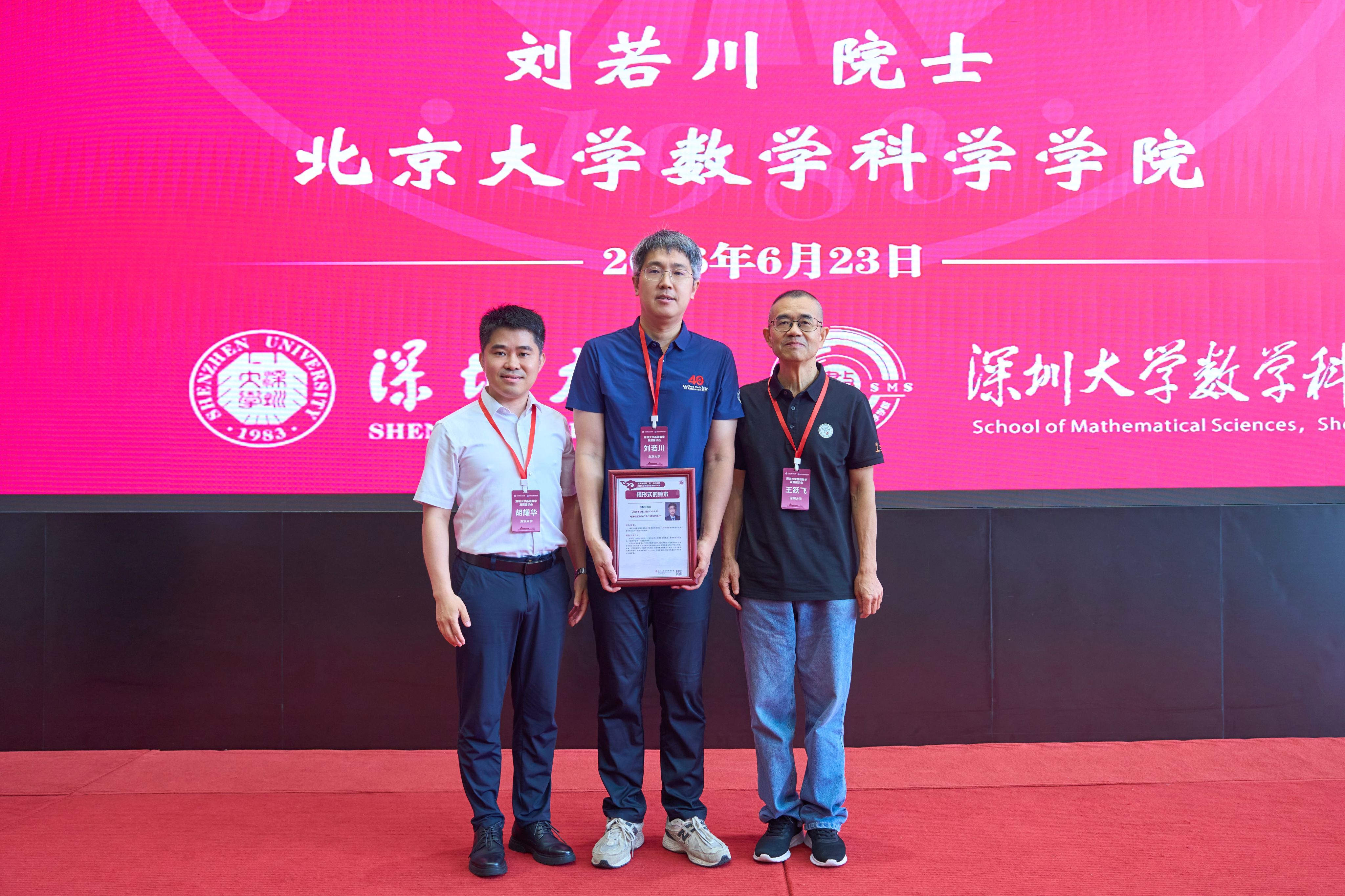
A plaque presentation ceremony followed.
The entire event concluded successfully amid a rich academic atmosphere. Academician Ruochuan Liu’s outstanding lecture not only provided Shenzhen University’s faculty and students with a high-level academic feast but also offered a valuable opportunity for everyone to gain insight into the frontiers of contemporary mathematics and appreciate the beauty of mathematics. It holds significant importance for advancing the development of the university’s mathematics discipline and fostering academic exchange.